Wilson alumni express dissatisfaction with name change proposal
May 24, 2021
Sally Schwartz can still picture the fury on her principal’s face as she and a band of classmates marched into his office, victoriously bearing a stack of papers scrawled with the signatures of every Wilson senior from the class of 1968. But clearer still, she can picture the twinkle in the eyes of Assistant Principal Vincent Reed as he watched the spectacle playing out before him.
The students had decided they would rather have an up-and-coming soul group play at their prom than the “white bread�? bands that traditionally played. Their principal was much less enthusiastic. Unwilling to entertain their request, the principal said he would agree on one condition that he figured was sure to snuff out their efforts: they would have to get every single senior to sign a petition in support. Which they did.
Reed secretly supported their effort, which Schwartz and the other students knew, but he didn’t let on as the principal threw the heap of papers back at them in a fit of rage.
Schwartz cites this fond memory as a prime example of Vincent Reed’s dedication to his students, one of many reasons she supported him to be the new namesake of Woodrow Wilson High School.
“The thing that was most consistent and what endeared him to so many people was he genuinely was all about the students. I mean, that is really what drove him. He was not a typical bureaucrat. He was not a typical person,�? Schwartz said.
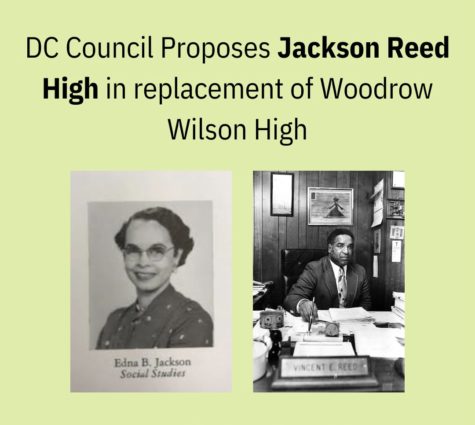
So it’s understandable that when Chancellor Lewis Ferebee proposed August Wilson as the new name for Wilson, Schwartz was disappointed—and she wasn’t the only one. Many alumni who rooted for either Reed or Edna Jackson, Wilson’s first Black teacher, felt DCPS passed up an immeasurable opportunity to honor an influential Black educator.
“If you don’t like Woodrow Wilson, why are you gonna keep the name? There’s so much [the community] could learn from Edna,�? said Thorval Hickman, who graduated from Wilson in 1960.
Hickman organized testimonials from his past classmates in support of Edna Jackson in the hopes that it might convince the DC Council to reject the proposal. Some cite her melodic voice, her dignified stature, and her extensive knowledge, but one consistency is the impact she left on them, more than half a century later.
Despite his arguments in favor of Jackson, Hickman initially didn’t want the name to be changed at all. He thinks that Woodrow Wilson’s reputation was unfairly sullied and had been actively opposing the name change. After realizing the class of 60’ was fighting a losing battle, he decided to redirect his energy to advocating for Jackson. And like many other alumni, Hickman believes that choosing August Wilson is just a “cheap shot�? and almost derisive to his legacy.
Tim Hannapel, a class of 1977 alumnus and co-founder of the DC History and Justice Collective, agrees. He finds the heartfelt testimonies for both Reed and Jackson to be incomparable to the arguments for August Wilson, which are often limited to the cost-effectiveness and convenience of choosing another “Wilson.�?
As a tenth grader, Hannapel took Jackson’s AP Modern European History class, and can still recall her warmth and the thoughtful way she taught. He hoped that Edna Jackson would be chosen, calling her the best teacher he’s ever had.
“There’s no DC public high school that’s named for a woman, much less a Black woman. How can that even be in 2021?�? he lamented. Hannapel was also frustrated that the Chancellor referenced August Wilson’s 29 percent majority on the public input survey circulated by DCPS last winter when the support for Reed and Jackson combined was 36 percent. “[August Wilson’s] support is 29 percent wide, but an inch deep,�? he said.
According to Hannapel, the DC History and Justice Collective will do all they can to convince the Council to reject the proposal. Already, they are encouraging community members to send personal emails to council members expressing their opposition.
Schwartz, though most vocal about her support for Reed, would have been all right with Jackson as well, having been her student. But she agrees that “to go through all this and have it still be ‘Wilson’ is really ludicrous.�? She also feels that DCPS’s process was hot transparent enough and didn’t sufficiently engage the community. She plans to express her thoughts to the council if given the opportunity.
“It’s just insulting,�? Schwartz said. Especially when Reed was such a devoted leader during a tumultuous time in Wilson’s history, she pointed out.
In the school year 1968-1969, when Reed was principal, Wilson was desegregated and Black students were bused to the school. Valerie Bell Youmans was one of them. She recalls crying for weeks when she found out she would be integrating Wilson instead of attending Roosevelt, her neighborhood school.
Although in hindsight she’s glad she went to Wilson because of the opportunities it gave her, the transition was difficult. “We faced a lot of racism, initially, going into Wilson—a group of Black kids coming from Roosevelt—and just having Vincent Reed there just made us feel a lot more comfortable,�? Youmans said.
Before the conversation about changing Wilson’s name gained traction a few years ago, Youmans was unaware that the namesake of the school she had desegregated was a racist. After looking into Woodrow Wilson’s history, she was shocked. “I thought it was ironic that we got bused to a school to desegregate DC Public Schools, and the school was named after a confirmed white supremacist,�? Youmans said.
Most alumni don’t have qualms with honoring August Wilson but would have preferred someone who had a direct impact on the school or the District.
“We just want [Reed’s] legacy to be remembered. I have nothing against August Wilson, he was a great playwright and it’s an easy choice in a way because it’s the same name. But August Wilson already has monuments,�? 1968 alumnus Mark Olshaker said.
Olshaker first met Reed when he was assigned to write about the new Assistant Principal for The Beacon in 1967. To his surprise, Reed already knew of Olshaker from studying the yearbook before he took up the position, in order to acquaint himself with the student body. The two developed a lifelong friendship that lasted until Reed’s death in 2017.
Schwartz was also a close friend of Reed’s and, despite her disappointment with the proposed name, she is mainly concerned with how Wilson’s community will treat it. She explained that if Wilson doesn’t capitalize on the name change as a way to reshape the school culture and expand inclusivity, they would be losing a valuable opportunity. “The name is just the name. The important thing is what the students and the faculty do with the name.�?